Software care
Your business software, looked after every week
Software isn’t finished when it goes live. The frameworks under it, the certificates in front of it and the threats around it keep moving. Software care means someone who knows your system is watching all of that, every week.
The promise
-
Your software is updated every week. Frameworks, packages and the platform it runs on, tested on a copy first.
-
Anything a check finds is fixed. It’s raised as tracked work on your portal, and you can follow it from found to live.
What you see
Everything on your client portal
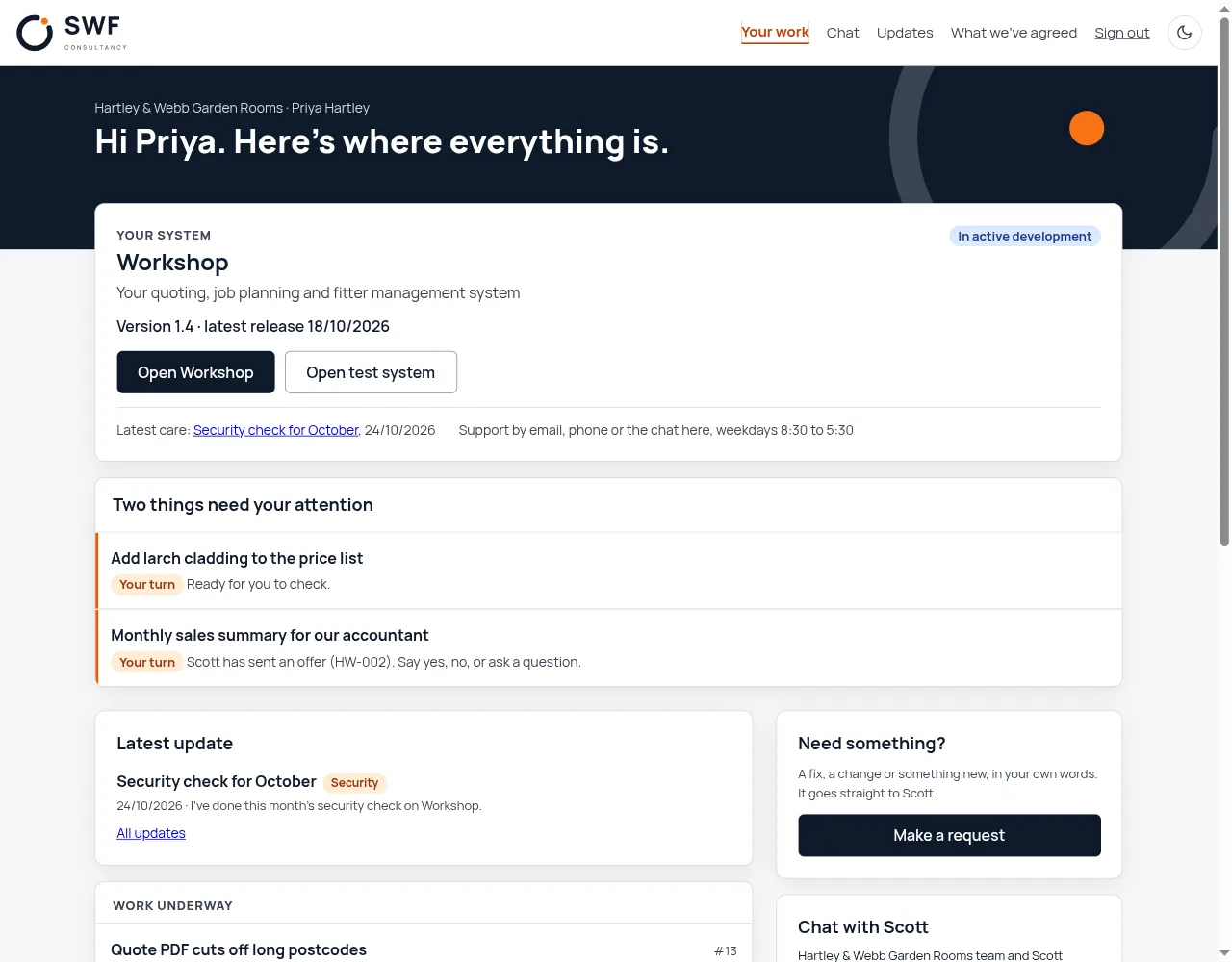
You don’t have to chase anyone to find out what’s happening. Your client portal shows it, and only emails you when something needs you or something has finished.
- Every request, and where it’s up to. A progress bar on each one, from Requested to Live, and a line saying what happens next and whose turn it is.
- Releases, with notes. What changed in each version, in plain English, and which of your requests went into it.
- A chat with me. For anything quick, shared with everyone at your business who uses the portal. Pictures go in the message where you put them.
- A weekly review. What happened this week, what’s next, and anything waiting on you. If nothing needs you, it says so.
The weekly check
Six things, every week
Dependency and framework updates
Every package and framework your system is built on, checked against its latest release. Fixes are applied on a test copy first.
Security advisories
Published vulnerabilities checked against what your system actually uses, not against everything in the world. A match is looked at the same week.
Certificate expiry
The certificate behind the padlock in your browser, and any others your system relies on, so nothing expires unnoticed on a Monday morning.
Uptime and response
Is it up, and is it answering as quickly as it should? A slow week is often the first sign of something else.
Runtime support dates
When the version of .NET (or anything else) your system runs on will stop getting security fixes, and a plan to move before it does.
What changed
What went into your system this week, and what changed around it: hosting, accounts, the services it talks to.
A security fault is never just noted. It’s raised as tracked work on your portal, with a plain-English line on what it means for you, and it’s fixed. You can watch it go from found to live like any other request.
Informed, never exposed
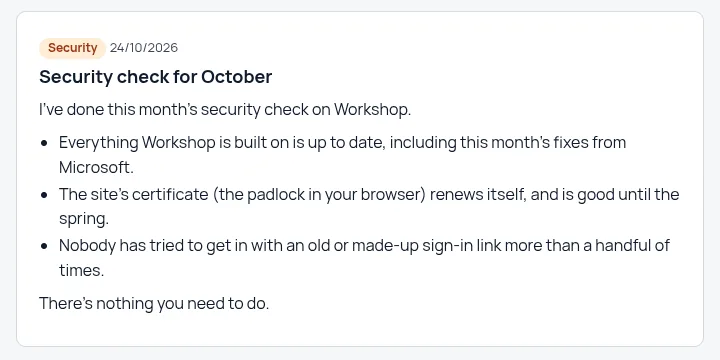
You hear what it means, not what the scanner said
Security tools produce long lists of codes and severity scores. Passing those on would make you feel informed without telling you anything, and a list like that is also a map for anyone who shouldn’t have it.
So you get the finding in plain English: what was checked, whether anything affects your system, what’s being done and whether you need to do anything. Usually you don’t. The technical detail stays with the fix.
Why it matters now
How fast it moves: php2shell, October 2026
On 21/10/2026 the PHP project fixed two flaws in PHP itself, CVE-2026-109618 and CVE-2026-109619, known as “php2shell”. Both allow remote code execution and are rated 9.2 (CVSS 4.0). According to PHP, both can be exploited by an attacker who doesn’t need to sign in. The US Cybersecurity and Infrastructure Security Agency (CISA) says they affect every way PHP serves web requests, so a website or system on an unpatched version could be taken over by a stranger on the internet.
- 17/10/2026Amazon Threat Intelligence sees a php2shell exploitation attempt against its honeypot network, four days before the flaws are public (reported by Tenable).
- 21/10/2026PHP releases fixed versions (8.5.12, 8.4.27, 8.3.36 and 8.2.35). CISA publishes an alert the same day.
- 23/10/2026Palo Alto Networks Unit 42 publishes a threat brief: its Cortex Xpanse telemetry finds over 22.6 million exposed instances potentially vulnerable.
- 26/10/2026CISA adds both CVEs to its Known Exploited Vulnerabilities catalogue.
How many systems were exposed depends on who counted. Unit 42’s 22.6 million is the largest figure; other researchers quoted by Tenable estimate 1.3 million and 1.9 million internet-facing hosts. Any of them is a lot of businesses with a few days to act, and older PHP versions that no longer get updates have no official fix at all.
The systems I build run on .NET, not PHP, so this one didn’t touch them. I use it because it shows the timescale: an exploitation attempt was seen four days before the fix existed, and five days after the fix, CISA had listed both flaws as known to be exploited. .NET has its own security updates, and the same clock applies.
More code, written faster, read less
AI coding tools mean more software is being written, and faster. I use them too: they write code, and I review, test and take responsibility for every line that reaches you (how that works). Not all code gets that read. In Veracode’s 2025 tests of more than 100 AI models on 80 coding tasks, the models introduced a vulnerability from the OWASP Top 10 list in 45% of test cases, and larger models did not do significantly better than smaller ones. Google’s 2024 DORA research found that 39% of the people it surveyed had little or no trust in AI-generated code, and that rising AI adoption went with an estimated 7.2% reduction in delivery stability.
None of that is a reason to avoid AI-written code. It is a reason to make sure someone keeps reading your system after it ships, because the mistakes it makes are the quiet kind.
The question isn’t whether a flaw appears. It’s how quickly someone who knows your system notices, and fixes it.
Common questions
Is software care only for systems you built?
It’s for systems I build or have taken on. If someone else built yours, the first step is getting to know it properly, because a weekly check is only as good as the understanding behind it.
What happens when the check finds a security problem?
It becomes a tracked request on your portal, explained in plain English, and it gets fixed. You see it move from found to live like any other piece of work.
Do I need to do anything each week?
No. Most weeks the review says what was checked and that nothing needs you. When something does, it shows as “Your turn” on your portal and you get an email.
What does it cost?
It depends on the system and how much it changes. Ask about ongoing care and we can talk it through.
Sources
- CISA: Critical Vulnerabilities in PHP Require Immediate Patching (21/10/2026, revised 26/10/2026)
- Palo Alto Networks Unit 42: Threat Brief, CVE-2026-109618 and CVE-2026-109619 (23/10/2026, updated 25/10/2026)
- Tenable: php2shell (CVE-2026-109618, CVE-2026-109619) frequently asked questions (21/10/2026, updated to 26/10/2026)
- Veracode: AI-generated code poses major security risks in nearly half of all development tasks (30/07/2025)
- Google Cloud: Announcing the 2024 DORA report (23/10/2024)
Figures checked against these pages on 28/10/2026.
Ongoing care
Ask about ongoing care
Tell me about the system your business runs on, who built it and what worries you about it. We’ll work out what looking after it properly involves.
Get in touch