-
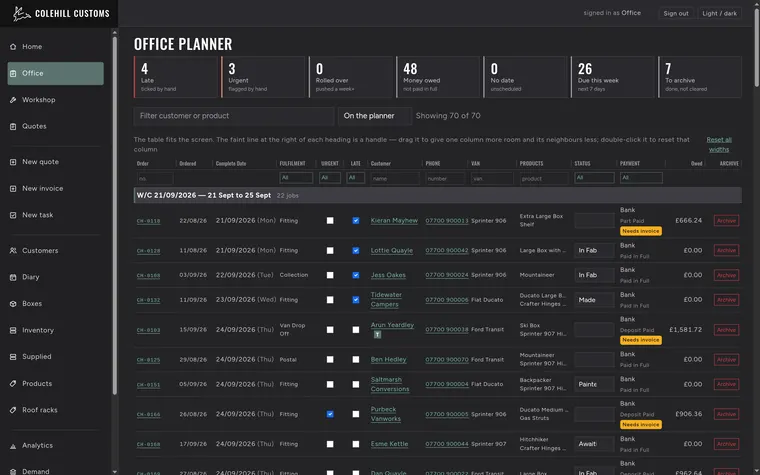
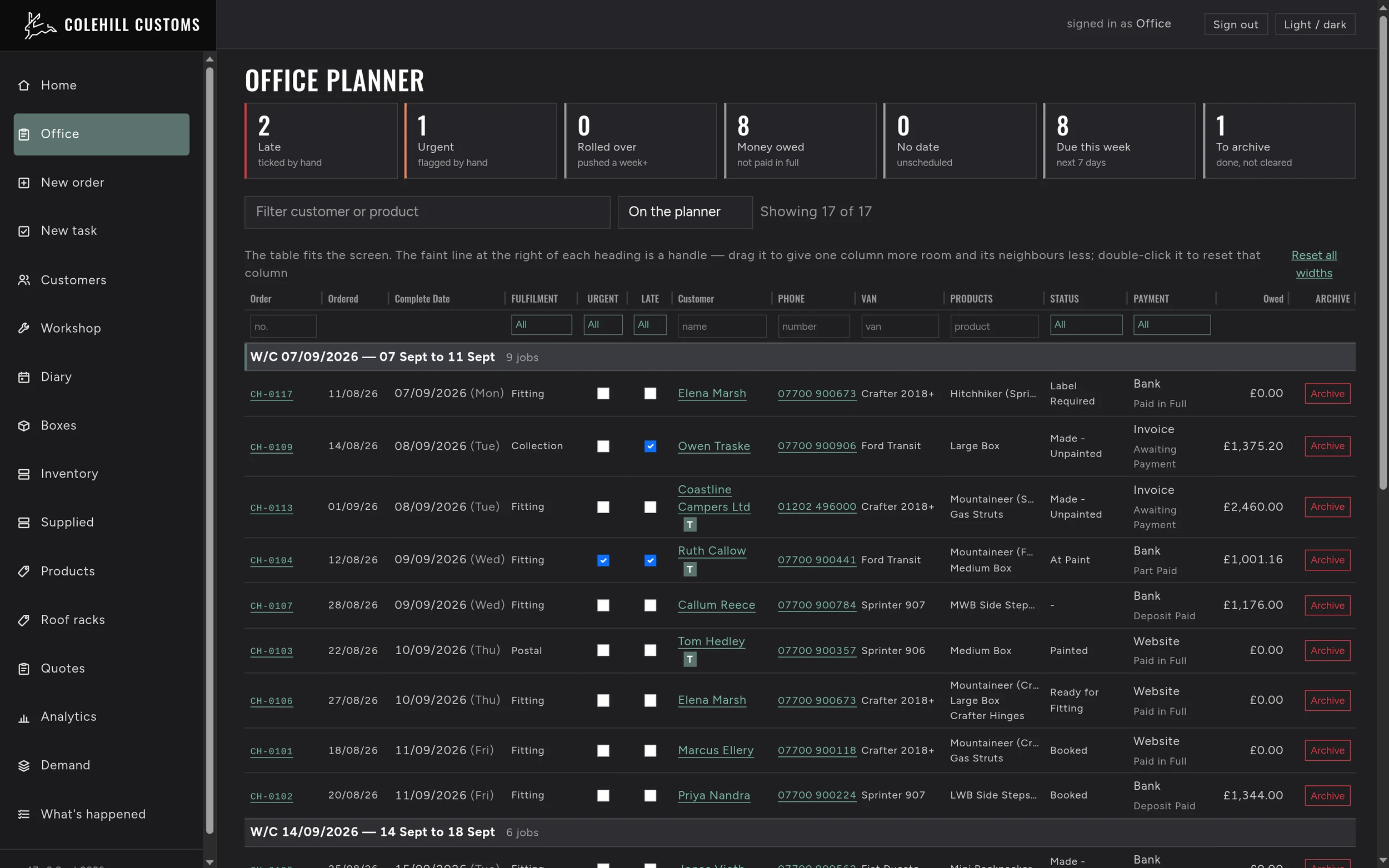
Office Planner
Every open job grouped into working weeks, with late and urgent flags, per-column filters, drag-to-resize columns, and money owed at a glance
-
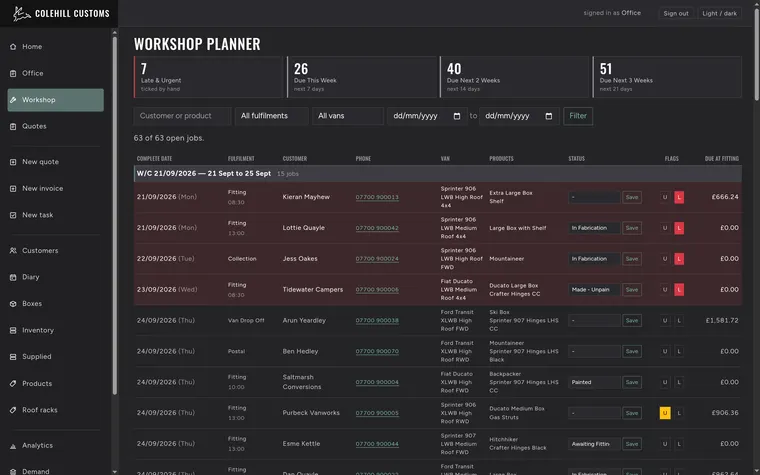
Workshop Planner
The same jobs on a fixed layout built for an iPad, with status editable in place and no live connection to drop
-
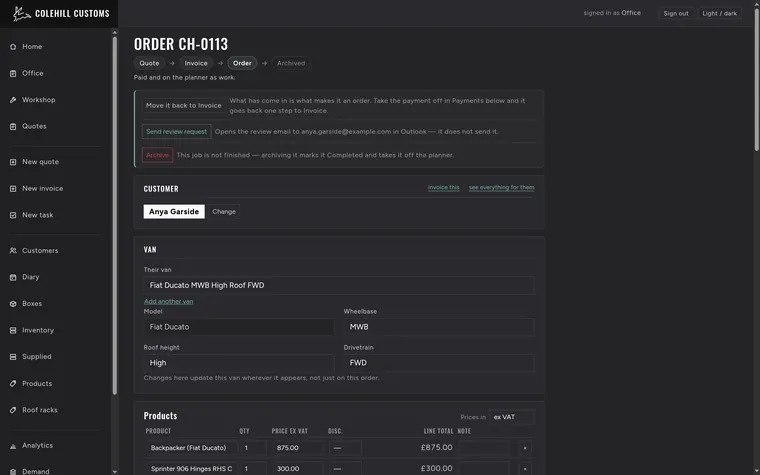
One-Screen Order
Quote → Invoice → Order → Archived as a single screen, with the customer, van, product lines, dates, invoice and payments all in one place, and a step backwards that puts stock and status back as they were
-
Shopify Integration
Website orders arrive on their own and are matched to the right customer, van and product from the line text; marking an order fulfilled in Shopify completes it here
-
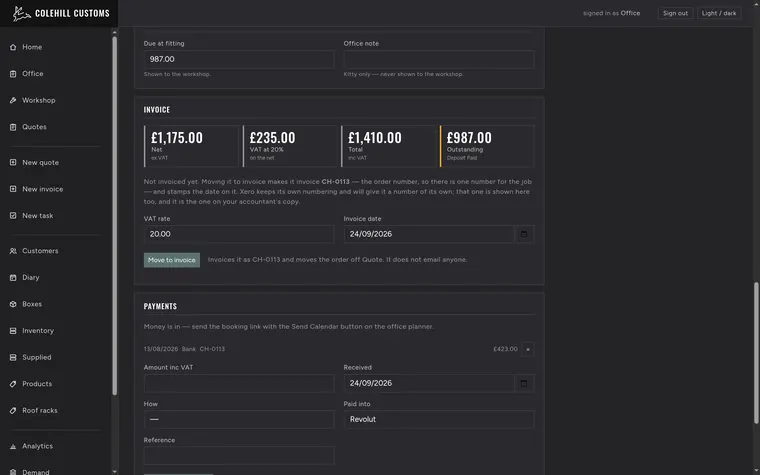
Xero Integration
Invoices and payments push straight to the accounts package, with per-payment bank accounts and Xero itself allocating the invoice number
-
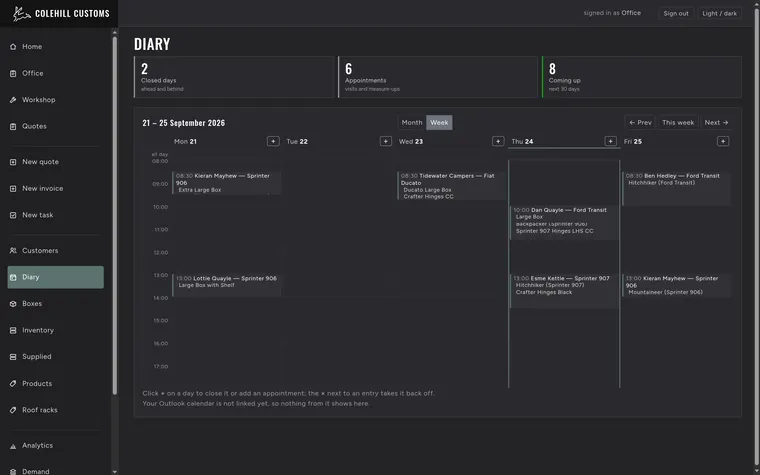
Fitting Diary
A week and month calendar of every booked fitting, overlaid with the office Outlook calendar, plus booking links that put the customer's chosen slot back onto the job
-
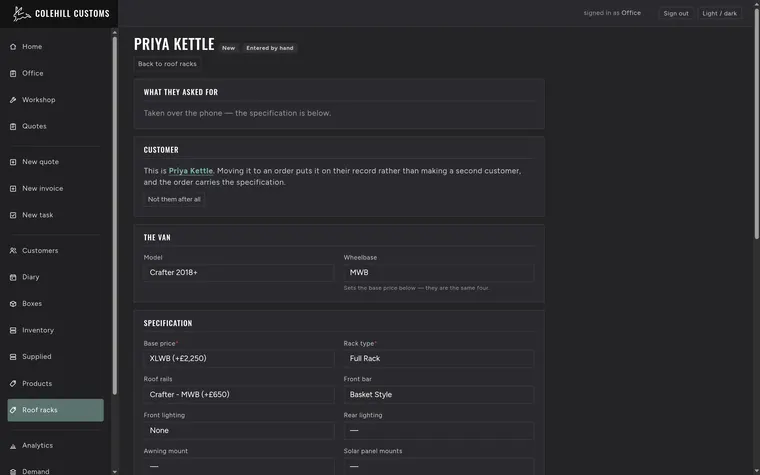
Roof Rack Configurator
Enquiries arrive from the website form, are priced against an editable option list, and produce a spec sheet the workshop builds from
-
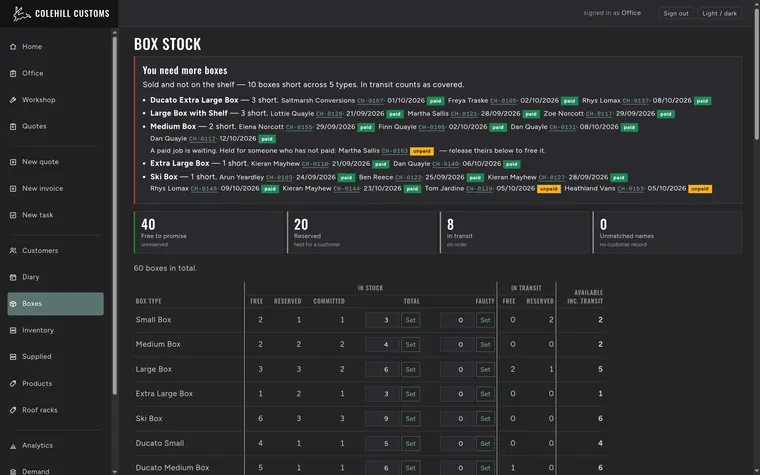
Stock & Supplier Orders
Boxes tracked individually and reserved against jobs, made-in-house stock separated from bought-in parts, and supplier orders received against what was ordered
-
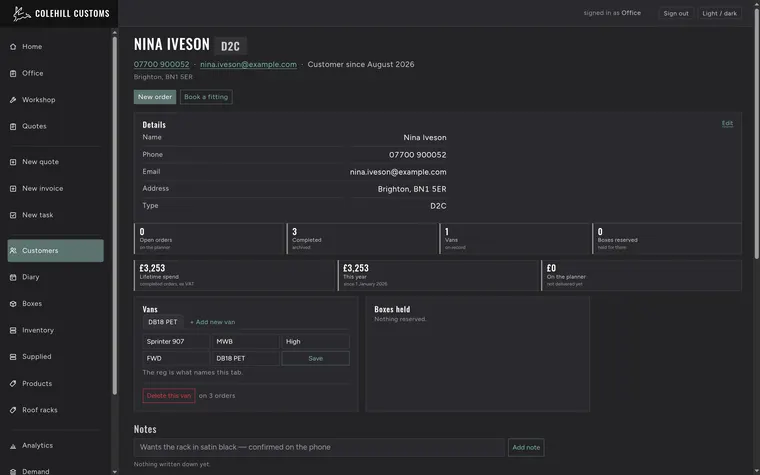
Customers & Trade Pricing
Customer records with their vans, notes and order history, and trade accounts with their own price lists resolved against the retail catalogue
Van Conversion Products & Fabrication
Colehill Customs
Production Planner with Shopify, Xero & Calendar Integration
- 47
- Releases in five weeks
- 258
- Automated tests
- 546
- Historic orders migrated
Before and after
What changed
Before
Colehill Customs design, fabricate and fit rear carriers, storage boxes, side steps and roof racks for camper van conversions. The whole business ran on one Excel workbook — a Weekly Schedule for production, a Box Tracker for stock, and a read-only mirror on an iPad so the workshop could see the week without breaking the live sheet. Orders arrived from a Shopify store, by phone and by email, and every one of them was typed in by hand. Invoicing was separate again, fitting slots were booked through a scheduling tool that knew nothing about the job, and nobody could see the whole picture: what was late, what was paid, what was actually in stock.
After
A bespoke Blazor Server web application on Azure, built from the spreadsheets outward. The office and the workshop each get the view they need — the same jobs, different screens, with access enforced on the request rather than by hiding a link. Shopify orders arrive on their own, Xero raises the invoices, fitting slots book through the calendar and land back on the planner, and stock is reserved and settled as jobs move through. It went live in the client's own Azure tenant a little over three weeks after the first look at their workbook.
This was AI-assisted development at full tilt: forty-seven releases and thirty-five database migrations in five weeks, most of them shipped the same day they were asked for. The client sent screen recordings of her own working week and the changes were live before the next one. That cadence is only possible because AI-assisted coding collapses the gap between "here is what is wrong" and a tested, deployed fix — the system now carries 258 automated tests, built as it went rather than bolted on. It also made the integrations affordable: Shopify, Xero, Calendly, Outlook and Jotform are five separate APIs, each with its own authentication and its own traps, and joining all five to a bespoke data model would traditionally have been the whole project rather than part of it.
Inside the system
The parts that do the work
“We were notably impressed by the efficiency of Scott's way of working - meaning the 1st draft of system, and revisions, were actioned extremely quickly - this meant the project was also way more cost effective than we initially thought!”
In full
We have used Scott to develop software for our exterior campervan accessories production company. After months of researching existing systems, none of which matched our criteria, we decided to look into something being made bespoke - which is where we found Scott!
We needed a system which integrated with Shopify & accounting systems, and provided a platform to manage in-person fittings/bookings, and postal orders. Not only that, but we wanted to have a CRM element, allowing us to track customers, quotes and inventory.
Scott has managed to create a totally bespoke solution for us, listening to all of our needs & concepts, and bringing them to life. We were notably impressed by the efficiency of Scott's way of working - meaning the 1st draft of system, and revisions, were actioned extremely quickly - this meant the project was also way more cost effective than we initially thought!
We have thoroughly enjoyed working with Scott on this project, and we will 100% use him for future developments to the platform.
Results
What it did for them
Replaced the Excel Weekly Planner and Box Tracker entirely — 546 historic orders, 390 customers, 1,131 order lines, 356 vans and 31 boxes migrated across
Shopify orders land in the planner unaided, correctly matched on customer, van, product and money — no re-keying
Invoices and payments reach the accounts package without a second entry, and the invoice number is the order number
- Fitting bookings, the office calendar and the production planner finally agree with one another
- The workshop sees the week on an iPad without being able to touch the office's money data — the split is enforced server-side
- Forty-seven releases in five weeks, backed by 258 automated tests
- Runs in the client's own Azure tenant on infrastructure costing under £15 a month — they own the system and the data outright
Next step
Got a similar problem?
Every system I build starts with a conversation. Tell me what your business needs and I'll tell you honestly what's possible.
Get in touch